This has been one of the hardest pieces of writing I have ever done, and one that has challenged me both personally and professionally.
There were days when we were still tracking down images and it felt highly unlikely that we would ever meet the printing deadlines, but thanks to the wonderful publishing team at New Holland, here is my new book, just in time for this year's Waitangi Day.
Wednesday, 28 January 2015
Friday, 16 January 2015
The secret of ideas
When I get asked questions about writing, I try to work out
what the person is actually asking (which is not always the same as what they
say.) Sometimes it's hard to do that at the time and I only realise afterwards
what they really meant. Many of the questions boil down to this: how do I
become a writer?
One question that always comes up (invariably, every single
time) is: Where do you get your ideas from? And if it's in a school visit, I
see the teachers lean forward expectantly, hoping that I will drop some words
of wisdom to inspire those children who complain about never having any ideas
of their own.
It's a such a short, innocuous question and I know they want
a short, easy answer (like the "ideas are all around you" answer.)
But as I ponder this question later, after the visit, I
wonder if many people think that "the idea" and "the story"
are much the same thing. That once you have trapped the idea, like catching a
butterfly, the story will follow without any trouble, like a child toddling
along after her mother. It will just magically happen on its own.
And it's not like that. You could give a dozen people the
same idea and they would come up with a dozen different stories, some good,
some - not so good. The ideas is just
the start. It's the working and reworking that makes the story
But that's sometimes hard to explain in a few minutes.
So here instead is what Neil Gaiman has to say about having ideas: how to be a successful writer.

Monday, 29 December 2014
Last book for 2014
The last book I've read for 2014 is Dear Leader by Jang Jin-Sung. The Guardian calls it "a telling account of the madness of North Korea", the country from which the author fled in 2004. It's a book I wouldn't have picked for myself and hadn't heard about, but it was given to us by someone with a deep interest in history. Last year he gave us Iron curtain which expanded my knowledge of the Cold War era by about 1000%, so I was confident this would be another intriguing read. And it certainly was, especially having read Adam Johnson's The orphan master's son as well.
Within the opening pages, I was struck by Jang Jin-Sung's description of how the writing process worked then (and presumably still does). He explains that every single writer in North Korea produces writing according to a bureaucratic chain of command, and "anyone who composes a work that has not been assigned to the writer through this chain of command is by definition guilty of treason". All written works are "initiated in response to a specific request" and have to be "legally approved" once handed in. "It is not the job of a writer to articulate new ideas or to experiment with aesthetics on his or her own whim."
It's true that it's difficult to make a living as a writer in New Zealand and we all worry about shrinking markets, disappearing bookshops and the future of the book. But at least we can write about whatever we want. We take freedom of expression so much for granted - thank goodness we have it.
If you're interested, you can read a short extract from the book by clicking on Free sample on the Random House website.

Thursday, 13 November 2014
Courage Day 2014
November 15 is marked around the world as The International Day of the Imprisoned Writer. This was started in 1981 by PEN, the international writers’
organisation, to acknowledge those writers around the world who are subject to
political, economic or other forms of repression.
Here in New Zealand we call it Courage Day, but many people don’t know
why, or assume it is called Courage Day across the world, because the name seems
so appropriate.
New Zealand Society of Authors (NZSA) members are encouraged every year to mark this day in some way. In the
past, we have had some compelling speakers who have helped us to explore the
idea of courage in writing.
This year, a small but committed group of NZSA Wellington branch members met on Thursday
13 November to explore the meaning behind Courage Day and to remember, acknowledge
and support those writers who are imprisoned or in danger because of what they
write. An empty chair stood as a silent representative of those who cannot
come to this or any other meeting because they are in prison or under
restraint, due to their writing.
- The story behind Courage Day
Courage Day is named
after two writers, Sarah and James Courage (grandmother and grandson). You can
read about them on the Christchurch City libraries website.
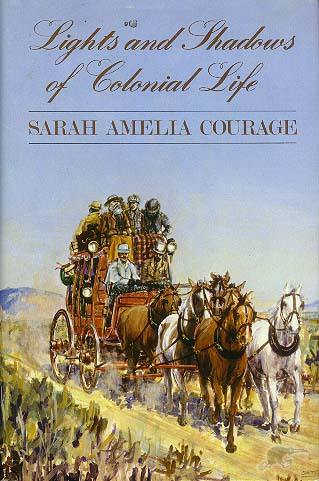
Sarah Amelia Courage (1845? – 1901) wrote a memoir in about
1896 called Lights and shadows of colonial
life: twenty six years in Canterbury, New Zealand (by “A settler’s wife”). Many
copies were burned by angry neighbours who didn’t like what she had written about
them. James Courage’s 1959 novel, A
way of love, was banned as indecent
because he dared to write about homosexual love.

Heather Hapeta
reminded us of other NZ writers and artists whose work has been banned over the
years, including Eddie Rout (Safe
marriage, 1926), Jean Devanny (The
butcher shop, 1926) and Ans Westra (Washday
at the Pa, 1964).
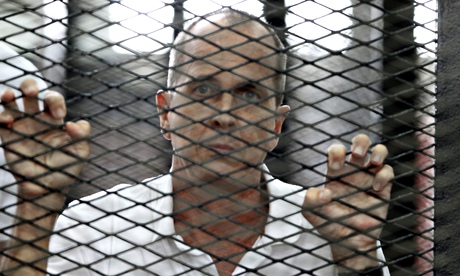
Maggie Rainey-Smith spoke about the jailed Australian al-Jazeera journalist Peter Greste, imprisoned in Egypt with two colleagues since June 2014 on charges of “aiding terrorists, smearing Egypt, and doctoring footage”. A newly issued decree allowing the deportation of foreigners accused of crimes on Egyptian soil is news that may hopefully lead to his release. Maggie spoke of hearing his mother interviewed on Radio NZ about how heart-wrenching it was to see her son appear in a Cairo court, shackled and without a translator. Elsewhere, Lois Greste has described visiting her son in an Egyptian prison for the first time as one of the most difficult days of her life.
![]() |
| Jailed al-Jazeera journalist Peter Greste, who was among three men jailed in Cairo in June on terror charges. Photograph: Khaled Elfiqi/EPA |
Lesley Marshall is the NZSA Writers in Prison committee co-ordinator and sends out numerous postcards to imprisoned writers. Recently she received a reply from Aron Atabek, a Kazakhstan poet imprisoned for writing a book critical of his government - and not just a reply but a poem, which Frances Cherry read out for us.
There is an empty chair in New Zealand –
Kept
for me on writers’ congress,That is the God to turn me –
Back to an ‘environment’, to a writer’s place!
![]() |
| The National Poetry Day event at the Butter Factory in Whangarei collected about 20 signatures and messages from the audience on a card for Aron Atabek, The event featured an empty chair displaying his photos and poetry, and Piet Nieuwland took a photo of it to include in the card. |
Every year, PEN international
highlights the situation of a number of particular writers. This year they included
poet and writer Enoh Meyomesse, currently held in prison in the Cameroon, and I
read out a brief bio of his work and an excerpt from his prison journal:
"... what's hardest for me is my eyesight. After those 30 days in total darkness in Bertoua, it's starting to go. My greatest worry these days is that before long I'm going to find myself totally blind..."
![]() |
| Dieudonné Enoh Meyomesse is currently serving a 7 year prison sentence for supposed complicity in the theft and illegal sale of gold. |
- For more info about Courage Day or the International Day of the Imprisoned Writer, see:
'I hope that you find comfort in the fact that
your words echo far and wide, reaching hearts and minds beyond the bars of your
cell, beyond the walls of your prison, reminding us that the freedom of speech
is worth fighting for.' (Elif Shafak writes
to imprisoned Chinese writer Gao Yu.)
Friday, 7 November 2014
World War One centenary events
It's hard to open a paper today (or look at a news website) and avoid reading about some WW1 centenary-related news item, artwork, installation or other commemorative event.
The poppies spilling out of the Tower of London poppies look breathtaking, and have attracted millions of visitors and lots of media attention. This dramatic installation by by ceramic artist Paul Cummins, titled Blood Swept Lands And Seas Of Red, is due to be dismantled on 12 November (the day after Armistice Day), but it has proved so popular that the hours of floodlighting have been increased and there have been calls for it to be extended. Volunteers have helped to plant the poppies in the moat and more volunteers will help to remove them. All of the 888,246 hand-made poppies have already been presold online, raising more than 15 million pounds for charity.
The installation is visually stunning, but there have been some thought-provoking responses to it. The Quakers have created a map to show how much of London would be covered if the poppies represented all the of the 19.5 million people from every country - soldiers and civilians, allies and enemies - and not just the British dead. And a challenging article by Jonathan Jones in the Guardian claimed that "an adequate work of art about the war has to show its horror, not sweep the grisly facts under a red carpet of artificial flowers."
An ad campaign that has also attracted some controversy is Sainburys' Christmas ad, based on accounts of German and Allied troops celebrating Christmas together in the trenches. Is it disrespectful for a supermarket to use WW1 to sell groceries? Or is is a reasonable and fitting way of letting people know what happened?
Here in Wellington, a number of buildings were illuminated over several nights with scenes of soldiers, war and New Zealand during the war years.
It's fascinating to see how people are choosing to remember the events of 100 years ago, but I think we have to keep reminding ourselves over and over what it is that we are remembering, and how we do that in the best and most meaningful way.
The poppies spilling out of the Tower of London poppies look breathtaking, and have attracted millions of visitors and lots of media attention. This dramatic installation by by ceramic artist Paul Cummins, titled Blood Swept Lands And Seas Of Red, is due to be dismantled on 12 November (the day after Armistice Day), but it has proved so popular that the hours of floodlighting have been increased and there have been calls for it to be extended. Volunteers have helped to plant the poppies in the moat and more volunteers will help to remove them. All of the 888,246 hand-made poppies have already been presold online, raising more than 15 million pounds for charity.
The installation is visually stunning, but there have been some thought-provoking responses to it. The Quakers have created a map to show how much of London would be covered if the poppies represented all the of the 19.5 million people from every country - soldiers and civilians, allies and enemies - and not just the British dead. And a challenging article by Jonathan Jones in the Guardian claimed that "an adequate work of art about the war has to show its horror, not sweep the grisly facts under a red carpet of artificial flowers."
An ad campaign that has also attracted some controversy is Sainburys' Christmas ad, based on accounts of German and Allied troops celebrating Christmas together in the trenches. Is it disrespectful for a supermarket to use WW1 to sell groceries? Or is is a reasonable and fitting way of letting people know what happened?
Here in Wellington, a number of buildings were illuminated over several nights with scenes of soldiers, war and New Zealand during the war years.
It's fascinating to see how people are choosing to remember the events of 100 years ago, but I think we have to keep reminding ourselves over and over what it is that we are remembering, and how we do that in the best and most meaningful way.
Tuesday, 12 August 2014
Holding on to Home: New Zealand Stories and Objects of the First World War
When Bob Kerr and I were sending our picture book Best mates out into the world, Kirstie Ross (Curator Modern New Zealand at the Museum of New Zealand Te Papa Tongarewa) was kind enough to come along to the Children's Bookshop (thanks to them for this photo) and officially launch it for us.
Now Kirstie and Kate Hunter (Associate Professor and Head of the History Programme at Victoria University of Wellington) have just published their own splendid title: Holding on to Home: New Zealand Stories and Objects of the First World War.
Kirstie and Kate were both speaking this week at Te Papa as part of the Writers on Mondays series. It was a wonderful talk, chaired by Paul Diamond, and looks like a fabulous book.

Paul asked about the process of working collaboratively on a book like this, and it apparently involved weekends away with masses of photocopies, to spend a couple of days literally walking through the piles of papers spread all over the floor. It was very moving to hear the authors read extracts from the book; Kate talked about wrist watches, often given to the soldiers as farewell gifts, and Kirstie about the "housewives" (pronounced "hussiffs") issued to the troops as sewing kits - this is an example from the Imperial War Museum's collection.
One thing I was especially interested in was when Kate talked about the difference between working with words and working with images. The images need to be "visually compelling", and some images that might still be fascinating to a historian just don't pass that on-the-page test. Kate said that you could tell when an image had "a voice of its own" and would work on the page. I could relate to all of that because it's exactly what I found when looking for images for my Anzac Day book.
I also liked the way they talked about the need to expand our idea of who were the New Zealanders at war - that it wasn't just the soldiers overseas, but also those back home, worried sick about their son/husband/father/brother/cousin at the front, or working hard to replace the male workers who had left, or putting their energies into opposing the war (like the conscientious objectors) - it was such a small country that almost everyone was involved or affected in some way.
The official launch of the book is next week, so look out for it in your local bookshop (or at Te Papa).
Thursday, 3 July 2014
It's not every morning that you have breakfast at Parliament ...
And this morning's was a very special event, to mark the 20th anniversary of Duffy's Books in Homes. As well as being served a delicious breakfast, we got to watch videos about the Books in Homes programme and listen to some great speakers, including Ben Carson, a black American paediatric neurosurgeon who was raised in a solo parent household with very little money. He tells the story of how his mother made him and his brother read two books a week, and write her a report on them for her, instead of watching so much television, and he credits reading with helping him out of poverty and setting him on the path to becoming a doctor.
The person I was sitting beside told me about a movie made about his life, called Gifted hands. Something else to put on the list of movies to watch. And now I've just checked, and the movie is based on a book - another book to read!
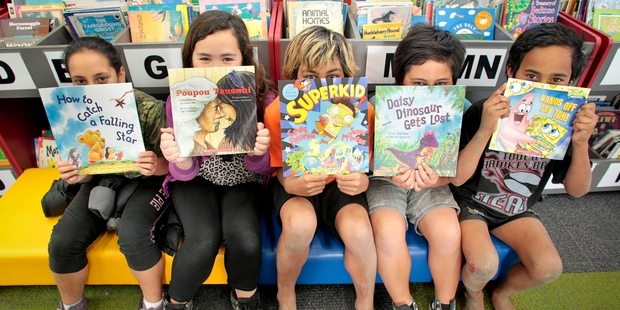
Christine Fernyhough and Alan Duff, who started the Books in Homes programme, also spoke, and pupils from Camberley School in Hastings - which saw the first ever Books in Schools visit - made a special trip down to Wellington to be present and sang three songs for us, including the Duffy song. I hope they enjoyed themselves, because they had to sit for a long time listening to grown-ups' speeches! But it was very nice to find this newspaper article about their visit.
You can read about the history of the books in homes programme here. Twenty years of operation and ten million books distributed to children from low-income families are two great milestones to have achieved.
The person I was sitting beside told me about a movie made about his life, called Gifted hands. Something else to put on the list of movies to watch. And now I've just checked, and the movie is based on a book - another book to read!
!
Christine Fernyhough and Alan Duff, who started the Books in Homes programme, also spoke, and pupils from Camberley School in Hastings - which saw the first ever Books in Schools visit - made a special trip down to Wellington to be present and sang three songs for us, including the Duffy song. I hope they enjoyed themselves, because they had to sit for a long time listening to grown-ups' speeches! But it was very nice to find this newspaper article about their visit.
![]() |
| Tequila Smith (left), Sativa Hooper, Sebastian Kohiti, Messines Roanaki, Kaiba Thompson of Camberley School, Hastings, are going to Wellington to celebrate Duffy Books in Homes' 20th anniversary. Photo/Warren Buckland |
You can read about the history of the books in homes programme here. Twenty years of operation and ten million books distributed to children from low-income families are two great milestones to have achieved.

Subscribe to:
Posts (Atom)