Friday, 26 October 2012

RSNZ Manhire Prize for Creative Science Writing

The shortlist for the Royal Society of New Zealand Manhire Prize for Creative Science Writing has just been announced on this page and I'm very pleased to be a finalist in the non fiction category.

This year's topic was on the future of science in New Zealand and it took its inspiration from the transit of Venus: "One day in 1769 the future of Aotearoa arrived quite unexpectedly, from the East, and in a form undreamt of. Just as it had some six centuries before. What future is on the horizon now?"


This competition always comes up with some fascinating entries and I'm looking forward to reading the other shortlisted ones, both fiction and non fiction.

Wednesday, 10 October 2012

The curious incident of the dog in the night time at the NationalTheatre


Our favourite cinema is the wonderful Penthouse cinema in Brooklyn and lately it's been possible to see not just movies there, but filmed versions of live performances - the Met Opera in New York, and from London the Proms at the Royal Albert Hall, Shakespeare at the Globe and various National Theatre performances.

The National Theatre ones and the Proms are apparently shown live at sites all around the UK. Here on the other side of the world we have to wait a bit longer, but you still get something of the sense of a live performance - you can see and hear the audience and the venue and sometimes the backdrop: the dome of St Paul's in the background and the London Eye all lit up, revolving above the Thames.


The show we've just seen was The curious incident of the dog in the night time, and it was fascinating to see how a book that is told so much from inside someone's head (and that 'someone" an autistic boy) could be translated to the stage. But it worked, and the sound and lighting and special effects all combined to give the effect of the overload on Christopher's mind when things got too much for him.


The set was also fascinating: hardly any props apart from numbered boxes and a trainset, but the floor was marked by a grid of small lights that could be turned on and off in patterns, and some of the best scenes involved intricate choreography of rest of the cast, all swirling around him at the train station or the Underground. The shots were sometimes filmed from directly above so I don't know if the audience would have got the same view, but the scenes of Christopher going down the escalator, or the train passengers looking out the window - which were both filmed with the cast lying down - were very clever.

It made me think about how acting - and playwriting - is such a collaborative process, and so different from sitting in a room on your own and writing a book. And how watching a play is equally a social event, as opposed to sitting reading a book by yourself. And how interesting it is when something like this is transformed from one medium to the other.


Sunday, 23 September 2012

Remembering Margaret Mahy

Remembering Margaret Mahy was the title of a symposium held on Saturday 22 September in Wellington, bringing together a collection of people - academics, writers, readers and fans - to talk about and celebrate Margaret's stories, poems, novels and film scripts. The event was organised by the English Department at Victoria University - in particular  by Kathryn Walls, and as she pointed out in her welcome, it was being held on what was indeed -


Tessa Duder's A writer's life has just been reissued with an updated biography and list of Margaret's books. Tessa set the scene with a summary of Margaret's life and achievements, from her early years as a writer when she was trying to combine motherhood with full-time work and would often stay up writing until nearly dawn. Later in the day she was sometimes known to fall asleep over her library filing cards, and thoughtful colleagues would quietly re-check her filing in the afternoon. Tessa went on to talk about the prolific writing years that followed, and the many prizes and awards she garnered, culminating in the prestigious Hans Christian Andersen Award (sometimes called "the little Nobel"), presented at Macau in 2006.

Margaret Mahy: A Writer's Life

Kay Hancock, former editor at Learning Media, is currently undertaking a PhD on the history of the Ready to Read series (aimed at Year 1 - 3 students)  which began in 1963, and she gave a fascinating overview of Margaret Mahy's involvement in this series, with a glimpse of just some of the many titles she wrote. Dr Vivien Van Rij from the Dept of Education at VUW followed this with a talk on Margaret's work for the School Journal. As a contributor to both series, I loved these two talks and the way they highlighted Margaret's fabulous work in this area. Her Ready to Read books such as Fantail, fantail or The bubbling crocodile must have been a delight  for any child to read, with their mix of charm, humour, clever rhythm and rhyme, rich language, appealing characters and warm family situations. I especially liked the cheerful, impulsive Crocodile who made a complete mess of the kitchen but was was enchanted by the foamy soap bubbles: "The Crocodile is a great lover of beauty,"' wrote Margaret.

During the break, we had a charming interlude in which Dr Marco Sonzogni, Current Director of the New Zealand Centre for Literary Translation, invited the Swiss Ambassador, Marion Weichelt Krupski, to launch a  publication from Wai-te-ata Press. The booklet is an excerpt from Margaret Mahy's The three legged cat translated into te reo and also the four languages of Switzerland: French, German, Italian and Romansh. Interestingly, there was a question at the end of the day about whether any of Margaret's works had been translated into te reo, and it's possible that this is the first.

Dave Gibson, from Gibson Group, said that working with Margaret was one of the fondest memories of his professional life. He kept us entertained, enthralled and occasionally slightly spooked with film clips from Cuckoo Land, The haunting of Barney Palmer and the rather creepy Typhon's People. Loved the singing, dancing IRD men and the wonderful Library Recovery team. Couldn't bear to watch the deletion of Phoenix in the test tube - although it turned out to be not quite what we thought. .

Harry Ricketts then introduced two writers who each gave a personal perspective on what Margaret and her work had meant to them. Eirlys Hunter spoke as a parent who had read and reread Margaret's picture books to her four children, and James Norcliffe as a near neighbour who was the grateful recipient - as many other writers were - of Margaret's legendary kindness and generosity.

After lunch, we heard from a number of other speakers,  focusing on Margaret's writing process, and often on one or more of her YA novels : Dr Claudia Marquis and Dr Rose Lovell-Smith from Auckland University, Dr Anna Smith from the University of Canterbury, Dr Babette Putz and Professor Kathryn Walls from Victoria University, and Trish Brooking from Otago University. Finally Dr Anna Jackson introduced Elizabeth Knox, who ended the day in style with a fine address on The other side of silence.


It was great to have this day set aside to talk about Margaret herself, her vast body of work and her wonderful legacy; how much we have lost with her passing, but how much of her we still have left. Everyone in the room went away not only with a renewed appreciation for Margaret's achievements, but also with a determination to go back and re-read all those wonderful stories, to enjoy them all over again and re-discover their depth and meaning.


Thursday, 20 September 2012

Two bulls, three pianos

On display for just one month at Te Papa is Michael Parekowhai's amazing installation titled On first looking into Chapman's Homer.

It's hard to describe in a way that does it justice, but it is breath-taking. Here's an attempt: it's a genuine Steinway grand piano, astonishingly red and intricately carved all over including the lid, flanked by two bronze pianos on top of which  are two incredibly life-like and life-size bulls, one standing and pawing the ground, one sitting.


Just after I arrived, two men wandered into the gallery. I don't think they were expecting to see it, because they looked surprised, then confused, then even more surprised and more confused. One of themn sidled over to the gallery attendant and asked, "What does this piece of art mean?" She replied with great aplomb, 'What does any piece of art mean?"


I'd read Mark Amery's review in the Dominion Post which really helped me relate to this work, especailly the references to the river and the landforms as viewed from the the water.

People can book a time to come and play the grand piano. When I was there, a man arrived, sat down and started to play Tom Lehrer's song "The elements", listing all the elements of the periodic table (at least as known in 1959, up to no 102), which made it seem even more surreal.

He also played another Tom Lehrer tune: 'Poisoning pigeons in the park'!

But there are also concerts on every day at 12.30 and it's on display until the 23rd - only a few more days now!


Thursday, 13 September 2012

Writers' and Readers' Week at WEGC

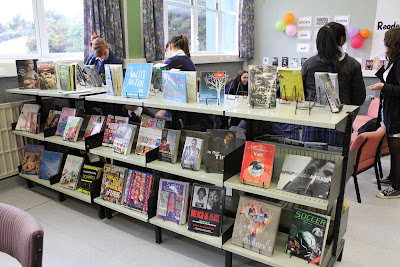
Last week I was invited to come and talk at the Writers' and Readers' Week held by Wellington East Girls' College to celebrate the re-opening of their library space.

I say "library space" rather than "new library", because Wellington East Girls' College (WEGC) has had its share of difficulties lately since the main block was found to be substantially below current safety standards for earthquake risk. The library was of course in the main block which is now closed. It's a beautiful old building so we all hope it can be saved. At night when it's lit up, it sails like a ship over the heights of Mt Victoria.

Both staff and students have had to be adaptable and resilient in dealing with a situation that has put stress on everyone. And the girls and teachers must be getting very fit when they often have to walk from the classrooms in the lower village all the way up to the new prefabs on the top field.

The library has had a whole year of homeless-ness, with the librarians using creative and innovative ways of bringing the mobile 'Library-2-U' but they now have an actual room, so the re-opening (to coincide with Readers' and Writers' Week) featured a week of events including a ribbon-cutting and opening ceremony, speeches and a book quiz. The girls were great to talk to and I really enjoyed my session.

One of the things I talked about (and read) was the story I submitted for the BNZ Young Writers' Award when I was in fifth form (now Year 11) at New Plymouth Girls' High School. It was Highly Commended and I told the girls that reading the judge's report, by Noel Hilliard, was the first time I had ever had any kind of contact with a real live writer.

The story is called Creation and you can find it on my website. I hadn't read it out loud before, because usually I talk to younger children at Writers in Schools visits to primary and intermediate schools. I thought afterwards that I should have warned them that they might be a bit confused for the first page or two (handwritten of course, no computers)  but that hopefully all would become clear, and I think it did.

I hope they're enjoying their new library space. And cheers to all school librarians who do such a great job (not always under such difficult circumstances.)

Friday, 31 August 2012

The (wonderful) Children's Bookshop, Kilbirnie


Birthday parties are always special, but how often do you get invited to a birthday party for a bookshop?

Twenty years ago, two people with little or no knowledge of bookselling opened up a small shop on a back alleyway in the Kilbirnie shopping centre and at the end of that day were part relieved, part exhilarated to realise they had made $250 worth of sales. Last night, a big and convivial crowd gathered in the shop (a bigger one, but still in the same alleyway)  to help John and Ruth McIntyre celebrate the 20th birthday of the wonderful Children's Bookshop. 

 
Original_childrensbookshop_banner


The bookshop was looking as fabulous as ever, with posters around the walls - reaching almost to the ceiling - and enticing book displays, set off by big bunches of congratulatory flowers on the counter. And the crowd inside reflected the wide range of people who value this bookshop so highly, including many local authors, illustrators and storytellers, other booksellers, school librarians and teachers, publishers' reps and staff, both past and present.

Annette King, who is a "neighbour" as well as local MP (her electorate office is right next door) began the speeches with a heartfelt tribute to all John and Ruth's hard work and their many awards and achievements over the last 20 years. She quoted from the article in the Dominion Post, describing them as "unsung heroes of Wellington", and said how true that was, but that we were there today to sing their praises. She also commented that whenever people weren't sure how to find her office, she simply had to say it was "next to The Children's Bookshop" and they would immediately be able to locate it.

Heidi talked on behalf of the staff, telling Ruth and John how wonderful they were to work for, and read out warm messages from others who couldn't be there, including David Hill and Diana Neild. Julia Marshall described the advice she'd been given by John when she was considering starting up Gecko Press, and pointed out how many other people have benefited from their helpful and wise suggestions. One of the publishers' reps described the bookshop as a "haven" in their busy day, and  one of their favourite places to visit (especially at morning tea time!)

But the star turn was undoubtedly Kate McIntyre, who has grown up with the shop - as she pointed out, it is only a few months older than she is. She told us that she'd only scribbled down a few notes an hour earlier, but she kept the audience captivated as she talked about what it had meant to her growing up with the bookshop as a second home, meeting world- famous authors, giving advice to book-buying customers as an eight-year-old and hanging out with the staff until she started proper "work" there at the age of about 15.

Finally John said a few words, and then there there was more wine and juice and deliveries of pizza, and lots more talk and a buzz of congratulations and admiration.

It was a great evening and a well-deserved celebration, with several themes that came through most of the speeches.  One was the quality of the staff whom John and Ruth have chosen and mentored, and how much they contribute to the bookshop's success, with their own wide reading enabling them to give valuable and reliable recommendations to  customers trying to choose the right book.

Another theme that emerged was is that it is all very well to set out to follow your dream, but a dream involves a lot of hard work and determination to make it succeed, and that's what Ruth and John have in bucketfuls.

So if you haven't been there for a while, make a visit and buy a book to celebrate their success and to wish them well for the next 20 years!

Tuesday, 21 August 2012

Walking home by Simon Armitage

Some years ago, I heard Simon Armitage when he was in Wellington for Writers and Readers Week, and bought his book All points north straight afterwards. Lately I've been enjoying his latest book,Walking home (sub-titled Travels with a troubadour on the Pennine way.) Simon Armitage is an English poet who came up with the idea of walking the Pennine Way north to south - against the prevailing weather conditions, and the usual direction of walking it - with the intention of finishing near his childhood home, a village called Marsden on the edge of the the Peak District. The idea was that the humiliation of failing to make Marsden would act as a spur to completing the 256- mile walk.


The trouble with many travel books is that they can be very self-absorbed. The writer makes it sound as though they are the only one exploring this fascinating part of the world, whereas if you've been there yourself, you know perfectly well that it must be swarming with other tourists. That's why I enjoy reading travel writers like Bill Bryson who can season their work with a lot of self-deprecating humour and write about fairly ordinary places while making them sound fascinating.

And that's why I'm really enjoying this book, because Simon Armitage is constantly poking gentle fun at himself and the whole idea of a 'travelling poet" (a big part of his expedition involved giving poetry readings each night) but his focus is usually outward, at the scenery, and the weather, and birds and flowers and geology, and the people he meets en route who take on board the "travelling poet" idea, offer him hospitality, organise the readings and become part of the whole project.


When we lived in England, we did a lot of walking in the Lake District, and also embarked on a misguided attempt to complete the  Coast to Coast walk in March. (It ended halfway across in a blizzard, so I can sympathise with some of Simon Armitage's descriptions of the inclement weather he encountered, even in summer.) We still have a couple of Alfred Wainwright's guides  - A pictorial guide to the Lakeland fells is one I've just picked off the bookshelf, Book Seven - the Western fells, crammed full of Wainwright's trademark maps and detailed drawings. So I'm also enjoying the language of the place names which are condensed poetry in themselves (from just one day's trek: Billysbeck bridge, High Cup Gill, Maize Beck, Meldon Hill, Birkdale Farm, the Cauldron Snout waterfall and the cliffs of Falcon Clints) as well as relishing the unusual and wonderful vocabulary he employs.

I also admire his determination to stick to his own rules, reading his poems in all sorts of venues after a long day's walk, when he must have been exhausted and yearning to hide away in a quiet place by himself.


The book is also peppered with references to other journeys, and other travelling poets - Wordsworth, the great walker, and Odysseus of course - and with occasional anecdotes that tell the stories behind some of the poems he reads, like "Causeway". Altogether it's a lovely mixture of travel book, memoir and poetry. I'm getting to the end of it now and I'll be sorry to come to the end of the journey.