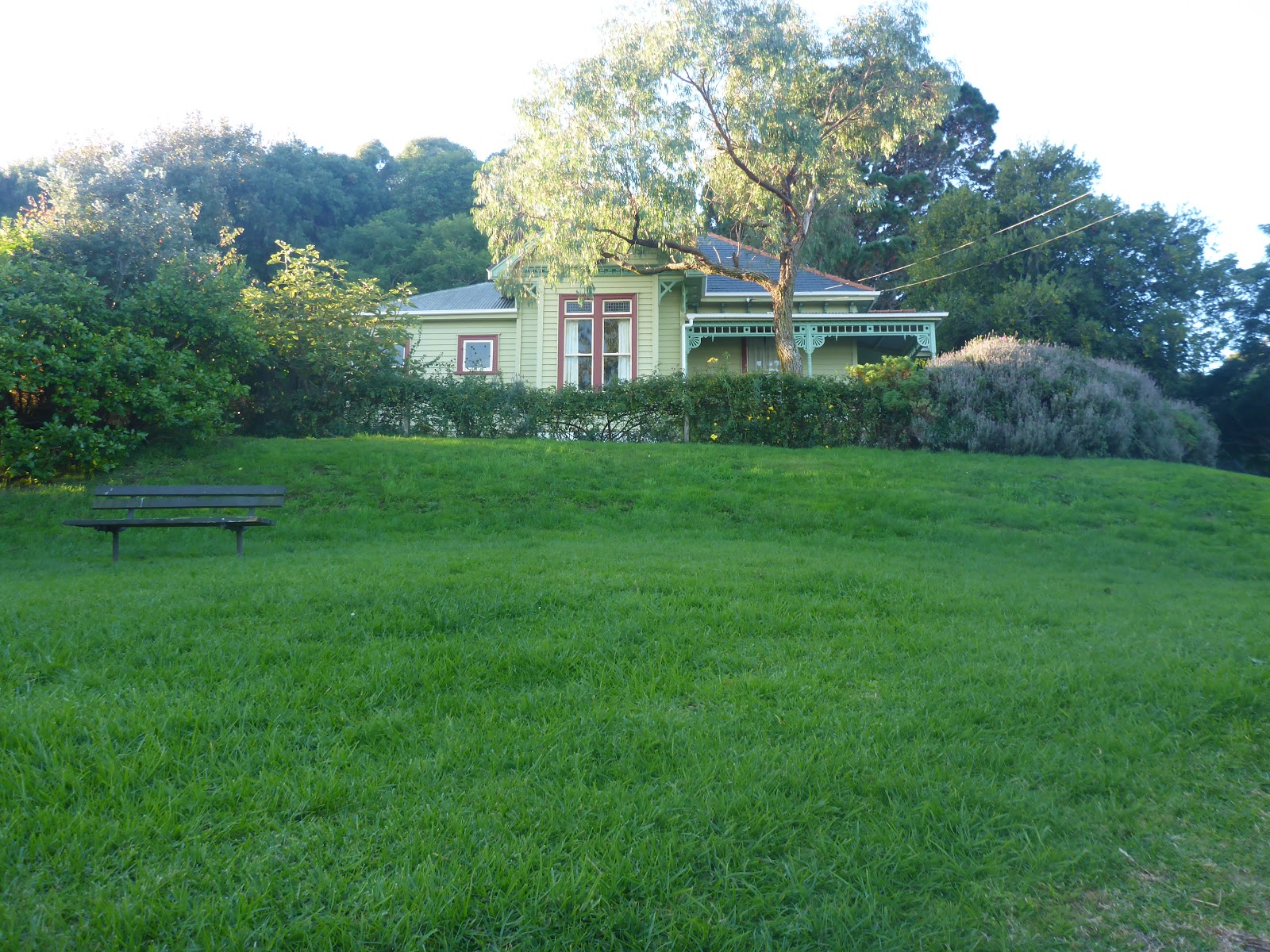
This is the Michael King Writers Centre on the southern slopes of Takarunga Mt Victoria in Devonport, Auckland.
Michael King never lived here (the house is actually the old Signalman's House) - but after he died in 2004, the Michael King Writers Studio Trust was formed to honour his memory, and this is the result. Sixty eight New Zealand writers have held residencies here since the centre opened in 2005, and I feel very fortunate to have spent two weeks there over Easter.
The view from the top of Takarunga Mt Victoria is amazing. The road is closed to most traffic now and every day there was a constant stream of people walking up past the house, both locals (often walking their dogs) and tourists. Every evening, people would gather on the summit to watch the sunset over the city.
Maungauika North Head is also a great place for a walk, with equally fantastic views and the added interest of mysterious tunnels.
And Cheltenham Beach is another beautiful spot nearby.
But the main reason people go there is to write! It's astonishing how much work you can do in two weeks with all the usual distractions removed. I loved going outside each morning and unlocking the writers' shed in the back garden.
And it's both moving and inspirational to be surrounded by paintings and photographs of Michael and his wife Maria, and photographs down the hallway of all the other writers who have lived and worked here.
It's a beautiful spot. Thanks again to Michael King, the Michael King Writers Centre and the Michael King Writers Studio Trust.
Thursday, 2 May 2019
Sunday, 3 March 2019
What do these two books have in common?
A non-fiction book about Antarctica and a young adult novel set in the last stages of World War One - what do these two books have in common?
I guess the answer is me! These are my two latest books, out now or soon to be released, and I'm very proud of both of them.
Antarctic Journeys tells the story of an amazing part of the world, and one that we in New Zealand feel a special connection to.
A few years ago I was lucky enough to go to Scott Base in Antarctica, and one of the things that struck me was that it is a place of journeys. Antarctica has no native inhabitants, no indigenous language or culture of its own and even today, nobody lives there permanently. People come for a summer or winter season, or several seasons, but everyone journeys there from somewhere and then leaves again.
This book tells the stories of Antarctic journeys, big and small, animal and human, scientific and practical, journeys of art and objects and memory, journeys through the landscape and into the far distant past. It is full of photographs, maps and illustrations, and some of them are mine!
You can read more about Antarctic Journeys here on my website.
I was going to say that The Telegram is quite different, but actually the heroine of this book, Beatrice (or Beaty), reminds me in a way of those early Antarctic explorers - she shares their qualities of courage, determination, endurance and resilience and she has her own journey of self-discovery to perform.
Beatrice is a telegram girl in a small New Zealand town in World War One. It's her job to bike around town delivering telegrams to people's front doors, and often the telegrams contain the worst of all possible news to the families of soldiers who have gone away to war. Rumours of peace start to spread, but Beaty's work continues all through the Armistice, the peace celebrations and the dreadful influenza epidemic. At the same time, she's writing to her friend and neighbour Caleb, somewhere on the Western Front - until his letters stop arriving.
Bob Docherty says that Beaty is a "treasure", and I think she's brilliant!
You can read more about The Telegram here on my website.
I guess the answer is me! These are my two latest books, out now or soon to be released, and I'm very proud of both of them.
Antarctic Journeys tells the story of an amazing part of the world, and one that we in New Zealand feel a special connection to.
A few years ago I was lucky enough to go to Scott Base in Antarctica, and one of the things that struck me was that it is a place of journeys. Antarctica has no native inhabitants, no indigenous language or culture of its own and even today, nobody lives there permanently. People come for a summer or winter season, or several seasons, but everyone journeys there from somewhere and then leaves again.
This book tells the stories of Antarctic journeys, big and small, animal and human, scientific and practical, journeys of art and objects and memory, journeys through the landscape and into the far distant past. It is full of photographs, maps and illustrations, and some of them are mine!
You can read more about Antarctic Journeys here on my website.
I was going to say that The Telegram is quite different, but actually the heroine of this book, Beatrice (or Beaty), reminds me in a way of those early Antarctic explorers - she shares their qualities of courage, determination, endurance and resilience and she has her own journey of self-discovery to perform.
Beatrice is a telegram girl in a small New Zealand town in World War One. It's her job to bike around town delivering telegrams to people's front doors, and often the telegrams contain the worst of all possible news to the families of soldiers who have gone away to war. Rumours of peace start to spread, but Beaty's work continues all through the Armistice, the peace celebrations and the dreadful influenza epidemic. At the same time, she's writing to her friend and neighbour Caleb, somewhere on the Western Front - until his letters stop arriving.
Bob Docherty says that Beaty is a "treasure", and I think she's brilliant!
You can read more about The Telegram here on my website.
Tuesday, 5 June 2018
NZ Book Awards for Children and Young Adults 2018
I'm delighted and grateful that The New Zealand Wars has been shortlisted for this year's NZ Book Awards for Children and Young Adults, amongst a crop of brilliant books by wonderful NZ authors. (Very special to have the non-fiction award named after Elsie Locke, too.)
Monday, 23 April 2018
Anzac Day 2018
On Anzac Day, I'll be remembering the great crew - Aussies and Kiwis, as well as our wonderful Turkish guide Baris, who made up the Gallipoli Volunteers team of 2014.
I'll be thinking of the Anzac services at Kaiparoro, Wairarapa, and Broweena, Queensland, two small communities that are continuing to commemorate the special link between them and their WW1 bridges.
I'll remember our tūpuna who travelled far from home to Gallipoli, the Western Front and the Pacific, including Louisa Bird, one of the first nurses to leave New Zealand for the war in April 1915.
At our local Anzac Day service, we'll remember the people from our community who left for war, some of whom didn't return.
This year, I'll also be thinking of those who lost their lives, their livelihoods, their land or their loved ones in the New Zealand Wars.
I'll be thinking of the Anzac services at Kaiparoro, Wairarapa, and Broweena, Queensland, two small communities that are continuing to commemorate the special link between them and their WW1 bridges.
I'll remember our tūpuna who travelled far from home to Gallipoli, the Western Front and the Pacific, including Louisa Bird, one of the first nurses to leave New Zealand for the war in April 1915.
At our local Anzac Day service, we'll remember the people from our community who left for war, some of whom didn't return.
This year, I'll also be thinking of those who lost their lives, their livelihoods, their land or their loved ones in the New Zealand Wars.
Wednesday, 22 November 2017
What I've been doing in the last 12 months
1. Visiting the great white continent
This time last year, I
was getting ready to head south. On 1 December, I flew down to Antarctica for a
week with the Antarctica NZ community engagement programme (formerly Artists
& Writers to Antarctica) at Scott Base. It was an astonishing experience and one that I
have thought about almost every day since then. It was hard and challenging and
exhausting and took me way outside my comfort zone, but it was also –
everything you can imagine about Antarctica.
One of the other people on the programme was Guy Frederick who produced two fabulous exhibitions for Canterbury Museum called Postcards to Antarctica and Postcards from Antarctica.
| First view of the sea ice |
| Field Training - my home for the night! Mt Erebus in the background. |
| Scott Base |
| The historic huts of the early Polar explorers were a total highlight for me. So well preserved and so atmospheric. |
I kept a blog while I was down there, which you can can read here - or just look at the photos!
Another piece of writing
to come out of this so far is a story called “Snow from the south” in the
anthology Wish upon a Southern star, a collection of retold fairytales edited by Shelley Chappell. Thanks to Shelley for all her hard work in putting this anthology together. You can read a review of the book on Bob's book blog.
2. Book Council Writers in Schools
The Book Council does
a great job of getting writers into schools to (hopefully) inspire students and
get them enthused about reading and writing. I always enjoy doing school visits and
this year, as well as some of the standard one-day visits, I’ve been involved
in the inaugural South Wairarapa community project of more indepth work spread
over a total of six visits.
I've loved visiting St Teresa's School in Featherston and it's been great to see such wonderful work produced by the students, some of whom weren't that keen on writing before. Thanks to Rm 5 for their thank you booklet which was an unexpected surprise!
3. New Zealand Society of
Authors (PEN NZ Inc) Te Puni Kaituhi o Aotearoa
If you’re a writer and
you already belong to the NZSA, you’ll know what a great organisation it is. If
you're a writer and you don’t belong, I’d encourage you to join. I’m on the committee of our local branch and also on the National Council as a regional
delegate. This year our branch meetings have included great speakers like Stephen Daisley, a panel discussion about the state of the NZ books
scene and fun events like the flash fiction evening.
4. Children’s war books
I’m still updating my Children's war books blog regularly although I realise now that I’m never going to catch up,
because there are so many excellent books being published, not to mention all
the classic titles.
5. The New Zealand Wars
This book has been my
major project for most of the year. It’s a topic that my previous non-fiction
books have led me towards, but one that is hard to summarise in a few lines and
I’ll write more about it on my website once the book is out next year. The
research involved several road trips, visiting memorials and old battlesites
that a few years ago I would have driven past without giving them a second
glance. Many people were kind and generous with their knowledge and expertise, and
one of the most powerful experiences of the year was going to stay at Parihaka
for a weekend to present my work to the people of the three marae there.
Another reason why
this has been a challenging topic is that when people have asked what I’ve been
working on, and I’ve said, “The New Zealand Wars”, I’ve had very muted
responses, compared to my other books. Many people look blank or puzzled. They
aren’t sure what or when the New Zealand Wars were, or just don’t have anything
to say.
I can totally relate
to this because this would have been me a few years ago, but writing this book
has made me look at New Zealand history and New Zealand society today in a
different way. It’s been one of the hardest things I’ve ever written, but also
one of the most rewarding.
| The site of the battle at Ruapekapeka in Northland |
| Memorial to the prisoners of Parihaka in Wellington |
| Gate Pa in Tauranga. I didn't even know about Gate Pa a few years ago. But it's as significant to NZ history as Gallipoli is. |
6. Storylines hui
Writing can be a very
solitary occupation, and it’s always a treat to get together with other
writers. Thanks to the hardworking
Storylines team who organised the Storylines hui in Auckland in October.
7. Wikipedia editing
OK this
might come across as slightly nerdy, but one of the most unexpectedly fun things
I did this year was go along to a Wikipedia Women in science workshop at the
Royal Society.
You know how teachers
advise their students not to use Wikipedia, and then everyone goes off and uses
it? Well, since the
workshop I have a lot more understanding of how Wikipedia actually works, and I
now think it’s a surprisingly reliable source, with built-in features
to make sure the material is accurate.
The main reason I went
along was to learn how to write up an article about Pamela Young, who was the
first New Zealand woman to live and work in Antarctica. I’ve now written another article as well, about Marie Darby, the first New Zealand woman to visit the
Antarctic mainland. This is all voluntary and unpaid of course, and also
anonymous, but I am quite chuffed to have this information available for anyone to read online.
I also found out about
the Wikiproject Women in Red. Do you know what percentage of English Wikipedia biographies are about women? Have a guess… If you said about 15%, you’d be approximately
correct. (It's currently sitting at 17.22%, up from 15% a few years ago, but the percentage does vary slightly from country to country.) The Women
in Red campaign aims to create pages for red links, where a name is highlighted
but doesn’t yet have a separate entry. (As opposed to blue links that do link
to a page.)
8. Radio NZ Short Story Club
This is Jesse
Mulligan’s bright idea: the Short Story Club on his afternoon show at 3pm on Thursdays, an excellent way to build some reading into your week. Jesse invites listeners to send in their own thoughts on the story being discussed, and I won a copy of Tracy Farr’s new book The hope fault for a comment about her story "Once had me". (I really wanted to win the book, so I put lots of thought into my email.) After that, I was invited on for the session on 10 August, when Jesse, Claire Mabey and I talked about "Paradise ducks" by Fiona Farrell.
9. Saying goodbye
It has been a sad year
for saying goodbye to some truly remarkable people. Barbara Murison’s cheery
tones ring in my head whenever I go to a book launch, and when I walk into the
Children’s Bookshop in Kilbirnie, I still half-expect to see John sitting at
his usual spot down the back.
There are many heartfelt tributes online to both Barbara and John. The Sapling has a collection of memories about Barbara here, and John's "life story" is on the Dominion Post here.
10. Other stuff
I've done some writing for educational publications (which involved some fascinating research on Navajo code talkers in World War Two) and had some plays published in the NSW school magazine and a poem in this beautiful book, Bird words (Penguin Random House, 2017).
I've read books (a lot of history around the NZ wars) and reviewed books for
the Sapling website (if you don’t know the Sapling yet, go and have a look; it is jam packed with great reading!)
There have been 21st birthdays, a wedding, new babies and lots of everyday life going on.
The Wellington Community Choir is a weekly highlight and if you get the chance to go along to one of their concerts, don't miss it. (Even better, come along and join the choir!)
Thanks to everyone who has asked about, been interested in or supported my writing this year. Thanks to the amazing Virginia Keast for lots of exercise-fun, helping to counteract the effects of hours of sedentary work. Thanks to everyone who has shared chat and news with me over coffee.
And if you're starting to think about Christmas presents - the best present is always a book! Preferably by a NZ author!
Monday, 19 September 2016
10 reasons I'm glad I went to the National Writers' Forum
1. Chris Cleave's wonderful keynote address, Hate is the .zip file of emotions, available for you to read right here.
2. Kate Pullinger on what it means to put text on a screen.
3. The bravery of all those who submitted opening paragraphs (and themselves!) for Live Live Editing.
4. Many great conversations over tea, coffee, lunch, drinks and dinner: tips, advice, encouragement, support.
5. Behind-the-scenes work by the organisers to make sure everything ran seamlessly - or when there were problems, we couldn't tell.
6. The Great Debate with a contentious topic and four very sharp debaters, ably (and wittily) chaired by Te Radar
7. Sarah Laing and Toby Morris persuading people who "can't draw" to draw.
8. Chris Cleave's masterclass on writing psychology, everything from Johnny Cash to how earphones are the trick to successful eavesdropping, and why we should pretend we're here visiting Earth on a 24-hour visit from the planet Mercury.
9. Basically, every word that Chris Cleave said for the whole weekend.
10. Top tips from Kate Pullinger, Chris Cleave, Stephen Daisley and Patricia Grace on what they wish they'd known about writing, back when they didn't know it.
Thanks yet again to those who had the vision to make this weekend happen. It was truly inspirational.
2. Kate Pullinger on what it means to put text on a screen.
3. The bravery of all those who submitted opening paragraphs (and themselves!) for Live Live Editing.
4. Many great conversations over tea, coffee, lunch, drinks and dinner: tips, advice, encouragement, support.
5. Behind-the-scenes work by the organisers to make sure everything ran seamlessly - or when there were problems, we couldn't tell.
6. The Great Debate with a contentious topic and four very sharp debaters, ably (and wittily) chaired by Te Radar
7. Sarah Laing and Toby Morris persuading people who "can't draw" to draw.
8. Chris Cleave's masterclass on writing psychology, everything from Johnny Cash to how earphones are the trick to successful eavesdropping, and why we should pretend we're here visiting Earth on a 24-hour visit from the planet Mercury.
9. Basically, every word that Chris Cleave said for the whole weekend.
10. Top tips from Kate Pullinger, Chris Cleave, Stephen Daisley and Patricia Grace on what they wish they'd known about writing, back when they didn't know it.
Thanks yet again to those who had the vision to make this weekend happen. It was truly inspirational.
Sunday, 18 September 2016
National Writers' Forum
Just back from an amazing weekend at the first ever National Writers' Forum. Huge thanks to Jackie Dennis, Claire Hill, Claire Mabey and all the organising team and sponsors, and to the NZSA for supporting writers in this very practical way, and thanks to all the writers - old friends and new - with whom I shared conversations over the past two days.
If you read one thing about writing this year, make it this keynote address by visiting speaker Chris Cleave - "Hate is the .zip file of emotions" - which he has generously shared on his website. In fact it has something to say to everyone, not just writers, so read it and pass it on, and then go and buy (or at least borrow from the library) one of his books, so he can continue writing and saying these wise and wonderful things.
![]() |
| Chris Cleave |
Subscribe to:
Posts (Atom)